
Clamping Force and Tie Bar Spacing in PET Preform Injection
Clamping force and tie bar spacing are the two mechanical limits that decide whether a mold can run on a PET preform injection machine at all. Clamping force is the closing pressure the machine applies to keep the mold halves shut while molten PET is injected and packed into the cavities. Tie bar spacing is the clear distance between the four tie bars, and it sets the largest mold the machine can physically accept.
Neither number answers the mold question on its own. A machine with enough tonnage but a narrow window cannot mount a wide multi-cavity tool; a machine with a generous window but insufficient force will flash at the parting line under injection pressure. This article explains what each element does mechanically, how the two interact, and how to size a mold against the 260, 318, 360 and 400-ton models in the Yongjiang range.
Problem Definition: Why a Tonnage Number Alone Cannot Answer the Mold Question
A preform mold is a pressure vessel that opens every cycle. Inside the cavities, molten PET is injected at high pressure, and that pressure acts on the projected area of the preforms and the runner, pushing the two mold halves apart. Clamping force exists to cancel that push. When a buyer shortlists a PET preform injection machine by tonnage alone, only half of the constraint is tested, and two different failures follow.
The first failure is separation. If the separating force exceeds the clamping force, the mold opens by a fraction of a millimetre at the parting line. The visible result is flash: thin fins of PET that must be trimmed, that disturb the neck finish, and that can damage the mold faces over time. Operators often react by raising injection or packing pressure, which increases the separating force and makes the flash worse.
The second failure is fit. A mold base can be small enough in projected area for a 260-ton machine and still be too wide to pass between its tie bars, particularly when the tool carries a hot runner manifold, valve-gate actuators, core-pulling cylinders and water manifolds. In that case no amount of tonnage helps, because the tool cannot be mounted.
Both failures are engineering problems rather than supplier problems, and both are settled before the purchase order is issued.
Industry Background: Where These Two Numbers Sit in Preform Manufacturing
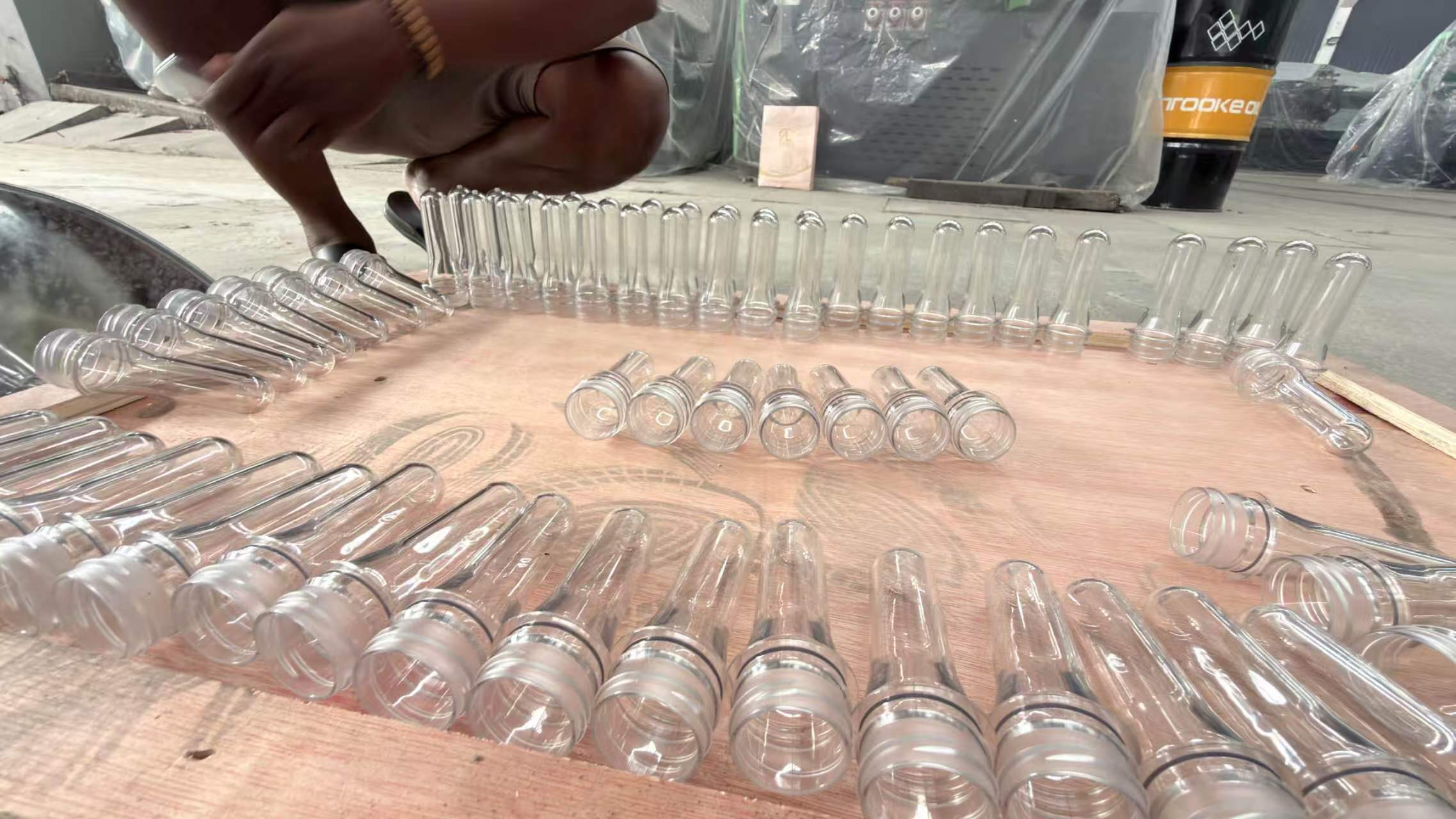
A PET preform is an intermediate product: it is injection molded first and blow molded afterwards into the finished bottle. Everything the bottle needs — the neck finish that accepts the cap, the wall distribution, the barrier behaviour — is established in the preform. Preforms serve bottled water, carbonated soft drinks, juices, edible oils and sauces, among other categories, and each category pushes the machine in a different direction: water towards high cavity counts and short cycles, edible oils towards heavier preforms and longer packing.
The equipment behind those preforms is tracked as a machinery category in its own right. Commercial research published by Acumen Research and Consulting projects the global PET preform machines market growing from USD 8.38 billion in 2022 to USD 14.73 billion by 2032. That figure describes the machine market, not the preform product market, and the two are frequently mixed together in supplier presentations.
Public procurement documents show how buyers write preform machine requirements. A CIPET tender specification from India required a machine tonnage of 150–200 T, a minimum shot capacity of 750 g, a minimum plasticizing capacity of 50 g per second, a minimum injection pressure of 1,200 bar and at least 32 preform cores and cavities, for a preform of maximum 20 g with a 28 mm neck for 1,000 ml bottles. Note what the document states and what it leaves out: tonnage, shot capacity, injection pressure and cavity count are listed, while tie bar spacing and mold thickness range are not. A buyer who checks only the listed numbers inherits an invisible risk.
How Clamping Force Works in PET Preform Injection
Clamping force is generated by the clamping unit and is quoted in tonnes or kilonewtons. It has one job: hold the mold closed while the injection unit fills and packs the cavities.
The force required is not the machine rating but the separating force of a specific mold, calculated as the total projected area multiplied by the cavity pressure, with a safety margin added.
Total projected area is the sum of every preform silhouette plus the runner and gate area. A 48-cavity tool does not grow only in its cavities; the runner system grows with it. This is the reason cavity count, more than bottle size alone, drives tonnage.
Too little force produces flash, dimensional drift at the neck and unstable packing. Too much force is not free either: it loads the tie bars and platens, accelerates wear on the mold faces and toggle pins, and can deflect platens enough to create uneven clamping across a wide mold. The objective is a margin, not a maximum.
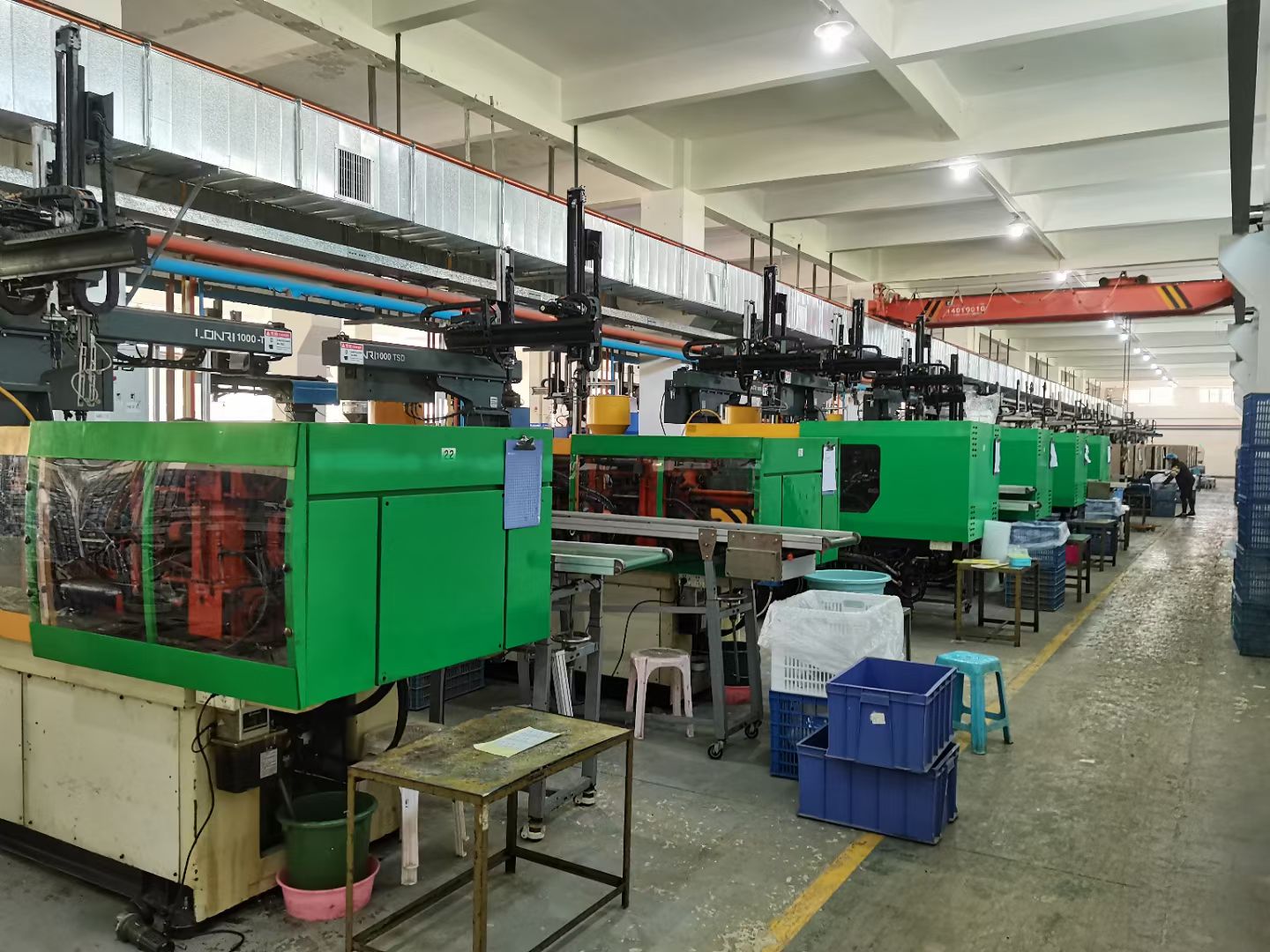
Yongjiang builds its PET preform machines around rigid clamping frames intended for multi-cavity hot runner molds in continuous production, which is the configuration where clamping stability matters most. The frame is the part of the machine that converts a tonnage rating into even pressure across the mold faces.
How Tie Bar Spacing Constrains Mold Size
Four tie bars carry the clamping force and guide the moving platen. The distance between them, published as two figures for the horizontal and vertical directions, is the gate through which every mold must pass.
Three sets of dimensions have to be checked against each other:
- Mold width and height against tie bar spacing, leaving clearance for clamps, water fittings, connectors and hoses.
- Mold thickness against the machine's minimum and maximum mold height, and against the clamp stroke, because the opening travel must be long enough to eject the preform and to let a take-out device enter.
- Component envelope: hot runner manifold, valve-gate actuators, cavity and core plates, ejector box and water manifolds all live inside the same footprint.
This is the constraint buyers discover late. Cavity count increases footprint as well as projected area, so a machine that is comfortable in tonnage can still be too narrow for a 48, 72 or 96-cavity tool. A high-cavity preform mold is wide before it is heavy.
Tie bar spacing also sets the practical side of production: mold change time, the space available for quick clamps, and whether a robot can reach the centre line of the mold for take-out.
Why the Two Numbers Must Be Read Together
The usable mold envelope of any PET preform injection machine is the intersection of two limits: the largest mold the clamp can hold shut, and the largest mold the tie bars will admit. Whichever limit is tighter governs the machine.
Read across the Yongjiang range and both limits move together. From the YJPT-260 to the YJHB-400, clamping force rises from 260 to 400 tonnes, tie bar spacing from 580 × 580 to 720 × 720, screw diameter from 72 mm to 95 mm and shot weight from 1,400 g to 3,450 g. The pairing is deliberate: a heavier shot and a larger mold base arrive together, so the machine that can fill a bigger tool can also close it and admit it.
The two ends of the range behave differently for a reason. The YJPT-318 and YJPT-360 share the same 80 kW motor and 65 kW heat power, yet the 360-ton unit adds 42 tonnes of clamping force, 60 units of tie bar spacing on each axis and 1,550 g of shot weight. That step is about mold size and shot volume, not about speed.
Comparison Table: Clamping Force and Tie Bar Spacing Across Four Models
| Model | Clamping force | Tie bar spacing (as published) | Screw diameter | Shot weight | Motor power | Heat power | Machine weight |
|---|---|---|---|---|---|---|---|
| YJPT-260 | 260 T | 580 × 580 | 72 mm | 1,400 g | 42 kW | 35 kW | 9 t |
| YJPT-318 | 318 T | 620 × 620 | 77 mm | 1,900 g | 80 kW | 65 kW | 13 t |
| YJPT-360 | 360 T | 680 × 680 | 95 mm | 3,450 g | 80 kW | 65 kW | 16 t |
| YJHB-400 | 400 T | 720 × 720 | 95 mm | 3,450 g | 80 kW | 65 kW | 16 t |
Tie bar dimensions are reproduced exactly as published in the model specification; shot weight, screw diameter, motor power, heat power and machine weight are quoted in the units published by the manufacturer. All four models are described as high-speed PET preform machines. The CE certificate CE20260126MD issued by ECM lists the YJPT-260 and the YJHB-400 within its scope under 2006/42/EC, EN ISO 12100:2010, EN 60204-1:2018+A1:2020 and EN ISO 20430:2020.
The two 3,450 g models are the clearest illustration of the central point. The YJPT-360 and YJHB-400 share the same screw diameter and shot weight, yet the 400-ton unit adds 40 tonnes of clamping force and 40 units of tie bar spacing on each axis. Shot capacity tells a buyer what the injection unit can deliver; tonnage and spacing tell a buyer what the clamp can hold and what it can admit.
Step-by-Step: Sizing a Mold to a Machine
The sequence below works for any preform project and keeps the two limits separate until the final comparison.
- Fix the bottle and the preform: bottle volume, neck finish, preform weight and application determine cavity spacing and cycle time.
- Choose the cavity count from the output target and the cycle.
- Calculate total projected area: cavity projected area multiplied by the number of cavities, plus runner and gate area.
- Apply cavity pressure and a safety factor to derive the required clamping force.
- Compare that figure with the rated clamping force of each candidate model and confirm the margin.
- Measure the mold base against tie bar spacing and subtract clearance for clamps and services.
- Check mold thickness against the minimum and maximum mold height, and check the clamp stroke against ejection and take-out.
- Check total shot weight, all cavities plus runner, against shot capacity.
- Check plasticizing capacity against the target cycle; the CIPET reference of 50 g per second indicates the order of magnitude procurement documents use.
- Confirm that the hot runner, valve gates and take-out automation fit inside the envelope before the mold is released for manufacture.
| Check | What is compared | Limit that binds |
|---|---|---|
| Clamp | Required clamping force vs rated tonnage | Flash at the parting line if under |
| Window | Mold plate width and height vs tie bar spacing | Mold cannot be mounted if over |
| Thickness | Mold stack height vs mold height range | No usable clamp force if outside |
| Stroke | Opening travel vs part ejection and take-out | Part cannot be removed if short |
| Shot | All cavities plus runner vs shot weight | Short shot or incomplete packing if over |
Use Cases: Where the Envelope Decision Changes
Water bottle preforms
Water is the segment that pushes cavity counts highest and cycles shortest, so it is the segment where the window and the clamp both become ceilings on cavity count. A buyer targeting a high-cavity tool should confirm tie bar spacing first and clamping force second, then verify shot weight for the whole tool.
Carbonated soft drinks
Carbonated soft drink preforms place the emphasis on neck and wall integrity. Uneven clamping across a wide mold shows up as dimensional variation at the neck, which is exactly the surface the cap has to seal against. Stable clamping is a quality requirement here, not only a flash-prevention measure.
Edible oil and sauces
These categories generally run heavier preforms with longer packing, and heavier preforms mean higher separating force for the same cavity count. The tonnage margin matters more than the speed specification.
Large containers and 5-gallon preforms
Large preforms run in low cavity counts but need wide cavity spacing and heavy shot weights, so the shot capacity and the mold footprint become the first limits while tonnage is rarely the binding constraint. In this case a machine is selected for shot weight and window before clamping force.
Converters running several bottle types
A converter with a mixed order book should size the machine to the widest mold it expects to run, not to the largest single order. The envelope that covers the mould set is worth more than a tonnage figure that covers only one tool. OEM supply from Yongjiang covers voltage and logo customization, which is relevant when the same machine platform has to serve several plants or markets.
FAQ
Does the CE certificate cover clamping force and tie bar spacing, or the machine as a whole?
The CE certificate CE20260126MD, issued by ECM, covers the PET preform injection molding machine models YJPT-260 and YJHB-400 and is valid from 30 January 2026 to 29 January 2031. The listed standards are 2006/42/EC (Machinery Directive), EN ISO 12100:2010, EN 60204-1:2018+A1:2020 and EN ISO 20430:2020. Conformity is declared for the machine as a configuration, so the clamping unit and the mold-mounting geometry belong to the same declaration rather than to separate specification values. A model outside the listed scope needs its own conformity documentation.
How do I check whether a specific mold fits between the tie bars?
Compare the mold plate width and height against the published tie bar spacing and leave clearance for clamps, water fittings and connectors. In the Yongjiang range the published spacing is 580 × 580 on the YJPT-260, 620 × 620 on the YJPT-318, 680 × 680 on the YJPT-360 and 720 × 720 on the YJHB-400. Then confirm that the total shot weight stays inside the machine's shot capacity, which is 1,400 g, 1,900 g, 3,450 g and 3,450 g respectively, and that the required clamping force stays below the rated tonnage. If either check fails, the mold and the model are mismatched even when the tonnage figure looks correct.
What does OEM supply from Yongjiang actually cover?
Ningbo Yong Jiang machine co.,Ltd is an injection molding machine manufacturer based in Ningbo, Zhejiang, China, producing PET preform machines alongside other injection molding machine types. Its OEM production services include technical services for voltage and logo customization. Minimum order quantity is 1 unit, lead time is 30–45 days, monthly capacity is 200 units, every machine is 100% tested one week before shipment, and 24/7 service support is provided. Clamping force and tie bar spacing are defined by the model — YJPT-260, YJPT-318, YJPT-360 or YJHB-400 — so an OEM project starts by selecting the model whose envelope matches the mold, then applying the customization.
How is a machine verified before shipment, and what commercial terms apply?
Acceptance is based on a pre-shipment test, and every unit is tested 100% one week before shipment. Commercial terms are MOQ 1 unit, FOB Ningbo, payment 30/70, with delivery in 30–45 days. A reference installation of 20 PET preform injection machines is in operation for PET preform making and water bottle making, with clients from Ethiopia, Spain, France and Hungary. To match a mold drawing to a model, send the mold dimensions, total shot weight and target cycle to yongjiangimm@gmail.com or request the catalogue from www.yongjiangimm.com.
Conclusion
Clamping force and tie bar spacing answer two different questions about the same mold. Clamping force answers whether the machine can keep the mold shut against the separating force of the cavities and runner. Tie bar spacing answers whether the mold can enter the machine in the first place. A preform machine is correctly sized only when both checks pass with margin, because a tonnage figure that looks generous can hide a window that is too narrow.
The practical rule is to calculate the projected area and the required force first, then measure the mold base against the published spacing, then confirm shot weight and plasticizing capacity against the cycle. Applied to the Yongjiang range, that sequence explains why the series moves from 260 T with 580 × 580 tie bars and a 1,400 g shot to 400 T with 720 × 720 tie bars and a 3,450 g shot: the four models cover different mold envelopes rather than different versions of the same envelope.
Ningbo Yong Jiang machine co.,Ltd manufactures the YJPT-260, YJPT-318, YJPT-360 and YJHB-400 PET preform injection machines in Ningbo, Zhejiang, China, and supplies them with OEM voltage and logo customization, MOQ 1 unit, 30–45 day lead times and 24/7 service support. Contact: yongjiangimm@gmail.com, tel and WhatsApp +86 18958305290, Jiangbei 88 avane, Ningbo City, Zhejiang Province, China, www.yongjiangimm.com.
Have Questions or Need More Details?
Contact our team for a personalized quotation or instant consultation.
Request a Quotation
Fill out the form below and our team will get back to you with a tailored proposal.
WhatsApp Direct Chat
Prefer to chat in real-time? Message us on WhatsApp for instant assistance & quick answers.
- Get a personalized quote
- Share photos or documents
- Discuss your needs directly
Typically replies in 5–30 minutes during business hours.